Monday, 20 August 2018

Jane Austen's Meryton - where was it?

Before I pose the theory Jane Austen did as many authors do today, and indeed shuffled the location of Meryton and Longbourn, thus placing it a county removed, she probably did so out of politesse to relatives and friends. After all, she had numerous connections within Berkshire, not least the Leigh side of the family. She also attended a boarding school in Reading, which was markedly different than Reading of today. She no doubt made friends, some better liked than others, a quite natural consequence of boarding establishments. It was known she was fond of Windsor and Wargrave, and Windsor itself was markedly different in her day. It was much smaller and rural in extremes, aside from the castle, as were other well known market towns and villages once situated outside London and now part of Greater London. Jane was an intrepid traveller as can be seen from reading her letters, and the distance between Reading, Wargrave, and Windsor pretty much traverses Berkshire. So with that in mind, hold that thought...   


This water colour of Jane Austen was painted by her sister, Cassandra. That much we do know!


But, there are several portraits purportedly that of Jane Austen, and not one of those portraits can truly be verified with absolute surety they are that of Jane Austen. I suppose desire to see the lady's face probably inspired artists to create impressions from descriptions, and while it may seem odd to us that there is no definitive record or extensive collection of Austen family portraits thus depicting Jane and Cassandra, one has to remember portraits were jolly expensive items in her day.       

Nonetheless she has become the most admired lady authoress of contemporary fiction - yes contemporary novels set within, and penned within her own lifetime. One can only ponder what Jane would have felt if she had become as popular in her own lifetime as has been her latter literary fortune since the mid 20th century and now into the 21st century, therefore, does not the word "ecstatic" leap to mind?   
Press images to see full size.

The original Lambourne House had Stuart connections - so what did Jane think of it? 

Now to the teaser questions that have puzzled Jane Austen fans for simply ages:

a) where is Meryton and where is Longbourn situated? 
b) was it wholly fictional, or did such a place exist in her time? 
c) did she change the name to disguise the places mentioned


This is a house once situated near Bath but no longer exists, and it was two counties distant to Berkshire, but Jane probably looked upon it with some regularity when passing by on her way to or from Bath. So much of old England is gone, the landscape changed from the days of the Georgian period, but as authors today search for houses and interiors suitable for depicting the lifestyle of fictional characters, Jane probably utilised those of which she was already familiar, or those she could only admire from a distance but readily suited to her fictional families.    

Rather than beat round bushes and lengthen suspension, or mayhap stir disbelief, I'll come out and say it, for I believe she pulled the same stunt as I do within my novels. by locating houses in differing places and changing the names. 

Is it not likely Jane Austen swapped the setting of Longbourn from Berkshire to Hertfordshire, thus she protected the occupants of the house she had used as inspiration for Longbourn. She had family connections within Berkshire, knew it extremely well. Perhaps mini anagrams exist and one day a clever person will unravel a puzzle Jane posed as a teaser game - find Meryton you'll discover Longbourn, or vice versa.     


Windsor was estimated at 24 miles + from London in Jane's time ,  and Jane was not only acquainted with Windsor (fond of it and the castle), she had resided in Reading as a boarder (school), and stayed in Wargrave, all three places on several main coaching routes to Bath, Gloucester, and Holyhead. Her family connections in the county cannot be denied. Aside from which, numerous country houses and estate parkland she would have seen and probably paid visit to on occasion, many vanished (demolished) to make way for modern  rebuilds or municipal housing in later times, plus modern post WWII housing estates were built in and around original parkland and grounds of former glorious houses, often the original estate's name then utilised for road names in like to example: Manor Hill Drive, Manor Hill Crescent, Manor Hill Terrace.      

Add the extra snippets, how at fifteen years of age she wrote an account of history. It was a tad satirical and amusing, but she revealed a great and abiding interest and affection for the Stuarts - Mary Queen of Scots to Charles I and presumably to the remainder of the Stuart era. Could she therefore be deemed a Royalist sympathiser or was her interest nothing more than general observance of those troubling times? We shall never know, but the tragedy of the French Revolution and the guillotine impacted on the Austen's in a personal sense. And her immediate family were later affected by the Napoleonic wars as were no doubt others of her acquaintance and theirs. No wonder then she chose to pen escapist writing, of a lighthearted and amusing bent, not only to escape the dreadful realities of the war dead and the returning wounded, there was always the constant fear great loss could befall the family all over again.        

Might that sense of knowing Berkshire too well set Jane to sage thought of exchanging one county for another? Could it be Meryton and Longbourn reflect places she knew within Berkshire? No one can know for sure, but it adds a new dimension in the search for both places, and perhaps a county distant for the fictional setting eased her conscience in writing of places she knew inside and out! 


Goodnestone Park Manor, Kent, the very house and family Jane Austen's brother married into. 


Here's another thought on Rosings and Pemberley, for Goodnestone Park Manor House was built in 1704 by Brook Bridges. It is accepted as fact the house build was started in 1704 because a brick on the main front declares it thus. We also know from early paintings there were extensive formal gardens, which were redesigned in the 19th century when Sir Brook Bridges, the 3rd baronet and great-grandson of the builder, replaced the gardens with a landscape parkland setting in the fashion of the time, later turned back to smaller contained gardens. He married Fanny Fowler, co-heiress of the ancient Norman barony of FitzWalter, though it was much depleted by the 19th century. In earlier times a Fitzwalter was one of the men who forced King John to sign the Magna Carta in 1215. The FitzWalters were renowned as courtiers (politicians too) and became Earls of Sussex with many cadet branches of the family. 

But back to J. Austen, for Brook and Fanny's daughter, Elizabeth, married Edward Austen, Jane Austen's brother, thus the pair's early married life was conducted at Goodnestone estate within the family fold until they removed to nearby Godmersham Park. There is a strange circumstance related to Edward Austen, for why did the Knight family adopt Edward from the Austen's and to later inherit the estate he had to change his name to Austen-Knight.  


Needless to say, Jane was a regular guest at Goodnestone in the early days of her brother's marriage. A significant factor therefore is that Jane began writing her first novel, Pride and Prejudice, immediately after staying at Goodnestone Park in 1796.


Did Jane utilise Goodnestone as Rosings, and Godmersham Park as Pemberley?  


Godmersham

She probably knew Brook Bridges (extremely wealthy) had bankrolled the marriage to Fanny by loans afforded to the ailing Fitzwalter estate. 
And of course Darcy's mother, Lady Anne Darcy and her sister Lady Catherine de Bourgh, were "Fitzwilliams"! We know the fictional Fitzwilliam (colonel Fitzwilliam) and the earldom had fallen short in monetary quarters, i.e. the estate was run down as was the Fitzwalter estate. 

Hence Jane, again, no doubt set Pemberley in Derbyshire to allay any connection with houses she was indeed familiar. Added to which she does indeed say Elizabeth and the Gardiners ventured to great houses of Derbyshire, not least that of Chatsworth.


The truth of the matter, it's a little sad how TV dramas and Movies have effectively provided Mr. Darcy with houses he could only dream of. 
The Duke of Devonshire's income was £35,000 from his estate at Chatsworth, copper mines and coal mines. 

The following two pictures are houses that were featured as that of Pemberley within TV dramas, namely:

Chatsworth.


Dyrham Park too provided an income of 20, 000 + from 250 acres and business interests. Twice Darcy's income. 


Dyrham Park

Both Chatsworth and Dyrham are almost as large as Blenheim Palace, the seat of the Duke's of Marlborough, and all well in excess of Darcy's  Regency era income.


Blenheim Palace.    


Food for thought, what say you, in how Jane Austen rarely if ever ventures to great detail on houses and fashions etc., and here's a little teaser: 

Jane began writing Pride and  Prejudice in 1796 and it was first published in 1813. It is said PP is set in 1812, so did the publisher, as they're of wont today, suggest she update it to a later time-frame, because it was completed long before its publication day.  Remember Jane lived through the years of the French Revolution 1789-1799.

After all, two of her brothers were naval officers and both were involved in action at sea. Jane had a cousin, the Comtesse Elizabeth de Feullide, Elizabeth sought sanctuary back in the family fold when her husband the Compte went to the guillotine. Elizabeth later married Henry Austen, and no doubt this is why Jane sought escape from the horrors of reality. In retrospect her novels are not a true depiction of her day despite her social awareness and collective impressions of wealth Vs poverty and bettering one's prospects. She did indeed gloss and paint a picture of rural delights with happy carefree picnics, soirees and much dancing as though the country was not at war with France and in 1812, America.  


Knowing the French nobility and aristocracy!


Louis XIV - The Sun King

With recent TV series' and movies depicting the differing reigns at the French Court, from the action adventures of The Three Musketeers, the Palace of the Louvre, other, to the glories of Versailles, all have graced our screens from the reign of Louis XIV’s father, to the sun king himself. We've thrilled and chilled to the realities of ambitious courtiers to the blood curdling reality of the French Revolution and the Napoleonic era. Thus novels with French settings are becoming popular within the historical romance genre. But, when writing historical romance novels set within France, whether in the feudal 13th century, the years of Louis XIV (the sun king), or later post French Revolution, there are aspects of the aristocracy across the centuries that has changed, as did the hierarchy of the nobles. Even knowing the difference between “Noblesse militaire” (of the Sword – granted for military prowess) and “Noblesse d’épée” (of the Robe – granted for service or relationship to the royal household) is vital in depiction of an aristocratic family.

Versailles the Series. 
The king, and his brother, Monsieur le duc d'Orleans. 

In short, it helps to know one’s history, and helps even more in understanding the French aristocracy and it’s lineage, so in summary:

Titles in the French aristocracy:
duc (duke)
marquis (marquis)
comte (earl)
vicomte (viscount)
baron (baron)
Chevalier (knight)and écuyer (rider)  were not titles.
They were merely ranks within the lower realms of the nobility, with a few exceptions, namely members of the knighthood of the king. All lesser noblemen no matter how recent in elevation to noble status were referred to as écuyer (rider).


Chevalier de Lorraine
A popular character in the series Versailles. 

The definition of a chevalier, in legal terms, was unclear for centuries. For some it was a matter of ancestry or a matter of eminence. It was found that legal documents, those whose nobility traced to 1410 or earlier – they were referred to as haut et puissant seigneur, while those whose families were connected by marriage to the royal house were très haut et très puissant seigneur. But, by Louis XIV the sun king’s reign, after the Baron’s Revolt, Noblesse militaire was considered of lesser nobility by the Noblesse d’épée - the latter with secure royal ties, either by blood or by marriage to members of the royal household.

It is worth noting "chevalier" was also used to refer to French Knights within the “Order of Saint John” (Order of Malta) as well as those within the French royal court: the use of the term makes it similar to a title such as monsieur le chevalier d'Lorraine - though not so; for it simply indicated membership in such an order, in general for younger sons of the nobility.

Lord (seigneur) was not a title, either. A lordship could be that of mere commoner and owner of land and property, inclusive tenanted property holdings. The term "lord" in the feudal system was a mixture of actual real estate and rights over people - rents and fees collected from them, certain obligations could be imposed on them. All lordships and the majority of aristocratic titles were abolished in 1789, until Napoleon became emperor and established a new common realm of aristocracy befitting his reign.

Forms of address at the French court of Louis XIV -when the “Church of France” came to fruition by Louis’ edict and his rebellion against the Vatican, thus the old feudal Seigneur of the former barons and knights was dropped in favour of Monsieur by aristocrats seeking closer favour with Louis. It was a direct kickback at the Holy Roman Church.

Monsieur le duc (duke)
Monsieur le marquis (marquis)
Monsieur le comte (earl)
Monsieur le vicomte (viscount)
Monsieur le baron (baron)
Monsieur le Chevalier (knight)

Forms of Address Prior to Louis XIV
Seigneur .........

As would be expected each fief, landed title bore more weight than mere lordly title in the days of the old barons: large or small. And yet, post the Baron’s Revolt, many great châteaux and the occasional castle soon fell into disrepair when they were not sequestered by the crown and awarded to newly titled favourites of the French court. But as courtiers were expected to reside within the walls of Versailles and attend upon the king – as and when, often their estates were badly neglected or merely mothballed within the hands of trusted retainers and a handful of minions.


Friday, 20 July 2018

Latest Release set during the City of Bath's Georgian Creation!


A little about my latest release! It's a novel I have become very fond of due to an ancestor of Francis Cavendish's, who held a special place in my heart when writing a series of novels set within the English Civil Wars. 


This is Francis Cavendish the hero! 
He was 18 yrs and newly returned from War when his portrait was painted. 
There is a heavily masked element within this image, and Francis is fortunate that men indeed wear facial powder (some theatrical paste) as well as powdered wigs in his lifetime. But when he rebels and sheds his false appearance reality strikes a cruel blow, at a time when vanity and perfection all things were uppermost. Thus his story begins when he's in his twenties and deep-seated hurt caused by one woman's cruel words haunt him, until he encounters Cassandra Brooke-Lavery. 

Whilst the Georgian era itself is looked upon as glorious period in history, in which ladies wore beautiful gowns, and gentlemen equally wore flamboyant attire, it was also a time of industrious architectural energy with the revival of great and ambitious building projects not seen since earlier times in Stuart England, when the rebuilding of London after the Great Fire of London was set out with plans Charles II approved with fervour. 

But, if one looks at houses built during the Stuart era, the resemblance of many Stately Homes such as Blenheim  Palace, Wilton House, and others, one can see reflections of those builds within the Georgian facades of Bath, Brighton, Cheltenham, and even Clifton in Bristol.

Whilst Francis holds no title and is no architect, he's descended from a long line of Bristol Merchant Venturers (Mountjoy and Thornton's) and that of an earldom within earlier English Civil War novels of mine featuring the Earl of Loxton. Francis  has inherited a vast fortune and becomes an investor, a young man with idealistic views as to what the City of Bath will become with vast crescents, and  glorious town houses. But his life is marred with personal unhappiness until by chance he makes the acquaintance of Cassandra.       

Book Blurb:

... “No one, absolutely no one will dare disturb us, unless the house catches fire”...

Cassandra never envisaged a week in the countryside with her cousin would lead to childish mischief. The prospect of the village stocks looms when they are caught trespassing within a grand country house. However, the law is the law, and the price of freedom in Cassandra’s case proves more costly than imagined, for she loses her heart to the very man whose portrait Sarah had fallen in love with, the man Sarah insists she will tempt and seduce at will. Cassandra’s release from custody by the man himself fuels jealousy and rivalry between her and Sarah. But when shocking revelations of a scandalous affair and illicit passions set precedence for a hasty elopement, stunned by it all, Cassandra discovers passionate asides can lead to true love and romance in the strangest of circumstance.

I hope and pray readers will enjoy this story for what it is - a touch of real-time history in the making and a touching love story! It's in paperback as well as e-book format. 

Tuesday, 5 June 2018

The Creation of Georgian Bath!


This is the City in which Jane Austen removed to from Hampshire, at a time in her life when the realities of renting property and feeding a household required a frugal existence. She related her findings of hardship within Sense and Sensibility, though her existence as a Parson's daughter was in stark contrast to that of the Dashwood's fall from the grand lifestyle of a vast country estate to the meagre confines of a little cottage in Devon. Nonetheless, rent paid for a house in Bath and no land on which to grow meat or produce for the house, monies soon fell short in Jane's life. Later, from her letters, we see she relied more and more on family charity and thereby a roof over her head, thus she moved from one residence to another with a great deal of regularity. There is a strange circumstance too, which is rarely spoken of - why did the Austen children live elsewhere rather than within the family house. Why did the Knight family adopt Edward? It was common practice in Jane Austen's time and long before and you can read why here. Cassandra too lived away a great deal, residing with family and the family her brother married into, hence numerous letters betwixt Jane and Cassandra. Read Jane's letters in Diedre le Faye's book compilation of Jane Austen's Letters.                

The City of Bath, set within the Vale of Avon, and within the County of Somerset, has long been looked upon as the Georgian City of Bath. And ever since Jane Austen lived there, albeit for a short while, few people realise her preference lay with Bristol, Clifton, in particular. Why might that be? If you've been to, or know Clifton, the answer lies in its elevation and the views which were spectacular in her day. 

Click on picture to enlarge!


View from Clifton before the grand terraces and crescents of Georgian Bristol were built. 


From Clifton she looked out across Bristol and the surrounding countryside to the River Avon below, and to the River Severn and the Bristol Channel (tidal waters) running betwixt the West Country and Wales. Clifton was quite unlike Bath, or the old City of Bristol. Although both city centres are set down in a basin surrounded by hills, quite small in modern terms, and at one time consisting of mediaeval buildings. Bristol had the advantage as the second most important sea port in England during the 16th-17th centuries, it was fought over time and time again throughout the years of the English Civil Wars (1642-1649), but as with other great sea ports, such as Plymouth, in the days of Sir Francis Drake, other ports gradually took precedence with shifting fortunes, political and military necessities of war with Napoleon. 

Sadly, in the height of the slave trade Bristol became blighted with a bad reputation for harbouring slavers. Hence as the abolition movement increased in momentum and focus centred on Bristol port in the late 1700s, slavers sought other ports and moved ships up north and to London with wares brought back from the West Indies to disguise their other trade.       

Bristol port was originally in the heart of the city, long since built on and all but disappeared barring a few remnants of the port, and the new port lies farther out on the Western edge of the city.


Bristol Harbour in the 1700s.   

The building of Georgian Bath began with the building of Milsom Street and other in 1762, instigated by Thomas Lightholder. The majority of the buildings were grand town houses incorporating existing detached properties, and it quickly became a commercial street when a bank took up residence followed by goldsmiths, modistes, tailors, et al. Bath was beginning towards a hub of social activity associated with the taking of the waters at the hot springs of the Roman Baths. Thus, Pulteney Bridge was completed in 1774, and likewise Great Pulteney Street and Laura Place became desirable residences. Before all that bridges were far lesser and required a little forethought in which route to take from Keynsham bridge to old bridge in bath, the same in coming from London to Bath, and schooners actually navigated upstream to Bath from Bristol on high tide. 


Old Bridge Bath. 

Earlier John Wood the elder (architect) had a grand visions for new build projects. He leased large tracts of land beyond the old city walls - his plan included Queen Square, the Parades, the Circus and other great ventures. His perception involved the grandeur of palaces combined with the practicality of mini mansions as private houses. Similar to today's builds, plots were individually leased to builders & tradesmen, all able to cater for tenants of differing purses, but each build was subject to Wood's façades of uniform Georgian splendour. His grand plans were created with the visions of Palladian grandeur, not altogether new within England, for similar could be seen with vast country estates such as Blenheim Palace, the Duke of Marlborough's grand house completed in 1722, and of course, the Duke of Devonshire's country estate Chatsworth, the new build which began in 1687, though both have Stuart influence as well.    


Two images of Pulteney Bridge to show how beautiful it was during the late 1700s


In both pictures one can see the original diagonal weir, not the modern weir of today that was built in the 20th century. At either side/end of the weir stood two grain mills!


One of the first Crescents to be built was The Royal Crescent and later, Lansdown Crescent (upper edge of pic in the distance) - note the boats on the Avon.


Another view of Lansdown Crescent.


And here we have the Royal Crescent - originally known only as The Crescent.  


Second perspective of the RC. 


And of course, as authors, we have to remember only the Lower Assembly rooms existed in the early part of Georgian Bath along with the original Pump Room.


Lower Assembly Rooms with Harrison's Walks (Gardens) Now part of the Parade, since the lower assembly rooms no longer exist.


The Pump Room - 
And one simply cannot mention Bath and leave Beau Nash out of the frame, he, who became the master of ceremonies within the City of Bath's social whirl, and he really did rule the social order with a metaphorical iron glove. 

Thus, the building of Georgian Bath plays a small background roll to my novel -
In Love with a Portrait. 

Sometimes it's nice to escape Regency England and step back in time to the Georgian period proper. And that's what I did. 


And this is Harrison's Walks in the present day - Parade Gardens.


Book Blurb:

... “No one, absolutely no one will dare disturb us, unless the house catches fire”...

Cassandra never envisaged a week in the countryside with her cousin would lead to childish mischief. The prospect of the village stocks looms when they are caught trespassing within a grand country house. However, the law is the law, and the price of freedom in Cassandra’s case proves more costly than imagined, for she loses her heart to the very man whose portrait Sarah had fallen in love with, the man Sarah insists she will tempt and seduce at will. Cassandra’s release from custody by the man himself fuels jealousy and rivalry between her and Sarah. But when shocking revelations of a scandalous affair and illicit passions set precedence for a hasty elopement, stunned by it all, Cassandra discovers passionate asides can lead to true love and romance in the strangest of circumstance.


Friday, 25 May 2018

Ratafia - Innocent Regency Cordial?

Ratafia


Renowned as a ladies cordial within the Regency era, though a much loved drink throughout the Georgian period, it is anything but as innocent as implied.

The ingredients suggest ladies enjoyed a little alcoholic tipple more than might be thought by those who had never partaken of the "supposed innocent" cordial!

Potent - or what?


Ingredients:


  • 1 quart of brandy


    • ½ bottle champagne

    • 1/2 cup of gin


    • ¼ cup of sugar

    • 2 oranges

    • 2 cups of cherries, pitted and squashed

    • 2 cups of blackberries

    • Dash of cinnamon

    • Dash of nutmeg

    • 1 teaspoon powdered rosemary
    • Three cloves (bruised)

    • ¼ cup crushed almonds

    The Process:
    Mix in a gallon glass jar. Cap jar and shake. Store in dark cupboard for three weeks, removing once a week to shake jar. 

    After three weeks, strain liquid through a cheesecloth, pressing down on solids to release their liquid. Distribute and store in several pint jars or tightly corked wine bottles.

    Tuesday, 15 May 2018

    Georgian Hairstyles pre-Regency era.

    Hairstyles of the Georgian period! 

    This article attempts to address the balance of hairstyles and fashion, because far too many readers and literary critics (who deem sense of expertise in matters of Georgian England) often seem to forget the greater part of the Georgian Period occurred within the 1700s - being that of  the 18th Century. Hence modicum of confusion arises with the coming of the Regency Era of the 1800s, being that of the 19th Century in matters of fashion, which includes hairstyles.


    In this picture are examples of Georgian hair styling.
    The first image represents back-combed hair with short ringlets and powered for fashionable effect.
    The second image is a young lady with natural hair in a pretty and becoming style, and this style remained popular for unmarried ladies until the coming of the Greek revivalist movement during the Regency era, when men went for the Corinthian, the Adonis, and other fashionable bent, whilst women went for short curls framing the face, top-knots and dangling ringlets.  
    The third picture is a strawberry-roan wig, no doubt similar in colour to the ladies natural hair colour, also lightly powdered.    

    To take stock of the early/mid part of the Georgian Period of England, it helps to remember Marie Antoinette was Queen of France, wife of Louis XVI at that time.


    Marie Antoinette.

    She was renowned for her outrageous wigs, but not all women during the Georgian period wore wigs, though some did, as did the Duchess of Devonshire when married, but when young she merely lightly powdered her hair and had it styled to the fashion of one long coil of hair over her shoulder similar the middle image top of page. 


    Duchess of Devonshire

    Other ladies of note, namely Lady Sheffield,  wore long style wigs.


    Whilst Mary Hamilton had her own hair styled and powdered.

    The following images are of TV/Movie productions, almost all with relevant hairstyles for the Georgian period - and pretty obvious which of these are wigs. Note the hairstyle bottom left corner which is totally wrong for Georgian period, not even early Victorian and is late Victorian /Edwardian. 


    Just prior to the Regency era, hairstyles were softer, wigs were worn far less by women who had lovely hair, though married women often still powdered their hair. And by now waistlines had crept upward, the A-line/French Empire line taking precedence. 


    By the Regency Era young girls were still given to wearing hair in loose coils (down) for informal dress, and up for formal occasions. Married ladies and mistresses always wore it up!


    In the year George, Prince of Wales, took office as the Prince Regent, the year of 1811, he assumed the working role of head of State in his father's stead. George III was sadly diagnosed as mentally incapable, thus the Prince of Wales, now Prince Regent had no idea when his father the king would die nor how long before he would become the monarch. 
    In 1820 The Regent became King. 
    The Regency era was at end, a mere 9 yrs in tenure, but Regency fashion and hairstyles continued until William IV became King on George IV's demise in 1830, merely ten years after the Regent became King. 

    During the reign of William IV ladies waistlines dropped, hairstyles went to buns and bunches, and silly side curls come the death of William in 1837, thus Princess Victoria became Queen.  


    Young Victoria!
      

    Sunday, 29 April 2018

    Book Covers Matter - or do they?


    “Book Covers Matter - Book Covers Matter”
    The above is the age-old Mantra of publishers, book designers, and authors alike.
    Then there’s the Secondary Mantra for Historical Novels!
    “Historical Accuracy is a Must- Historical Accuracy is a Must”
    ~
    And one would suppose that in the sphere of Historical Romance the Accuracy Mantra would be essential to depict accurately a Genre, Period in History, and Theme.
    Not so, Not so... Anything goes!

    Sadly, Historical Romance novels have transitioned across the years from the early days of elegant covers with inanimate objects or sensual painted pose.


    to the Bodice-Ripper era


    to the Headless or semi-headless Heroine era


    to the now Fantasy era of women bare-backed/half stripped, and those models in modern shirts. 


    Ahhhhhhhhh The shirt is all Wrong!


    Effectively covers have gone from the sublime to the ridiculous with supposed Historical Heroines depicted wearing modern Prom dresses or Fancy Dress Disneyesque frocks instead of Period Perfect Gowns. If that wasn’t enough to have officiandos of Historical accuracy cringing as they peruse book lists at Amazon, the mens' shirts can cause outrage amidst re-enactor communities and the Period Specific nerds, the latter of which I am one of many!


    A shirtless hero is by far preferable to one wearing incorrect attire for the period depicted within the pages of the novel.

      Nap-Shirt 


    Lace Jabot


     And it should be remembered button-through shirts didn’t exist prior to the 18th and throughout the Georgian period as a whole - inclusive the Regency period. But true enough, during the late Victorian era button-through shirts gradually came to fruition. So do not have your hero or heroine unbuttoning his shirt, unless you are writing a late-Victorian/Edwardian era novel. And remember smock shirts were still customary wear for the average Joe, as were nightshirts. It may also surprise readers and authors to learn ready-made attachments, such as frilled cuffs and a jabot - the former affixed with looped-through ties and the latter with back-buttons.


    Button-Through Victorian Dress shirt!

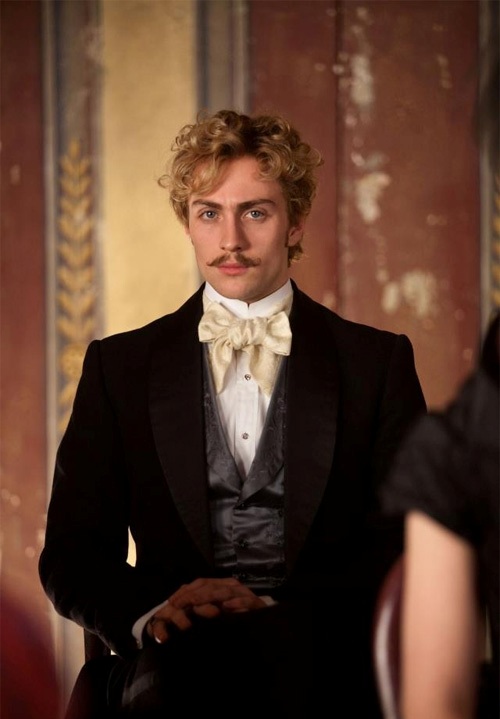
    Don't you just love that moustache... Tickle me, do...