Thursday, 26 January 2017

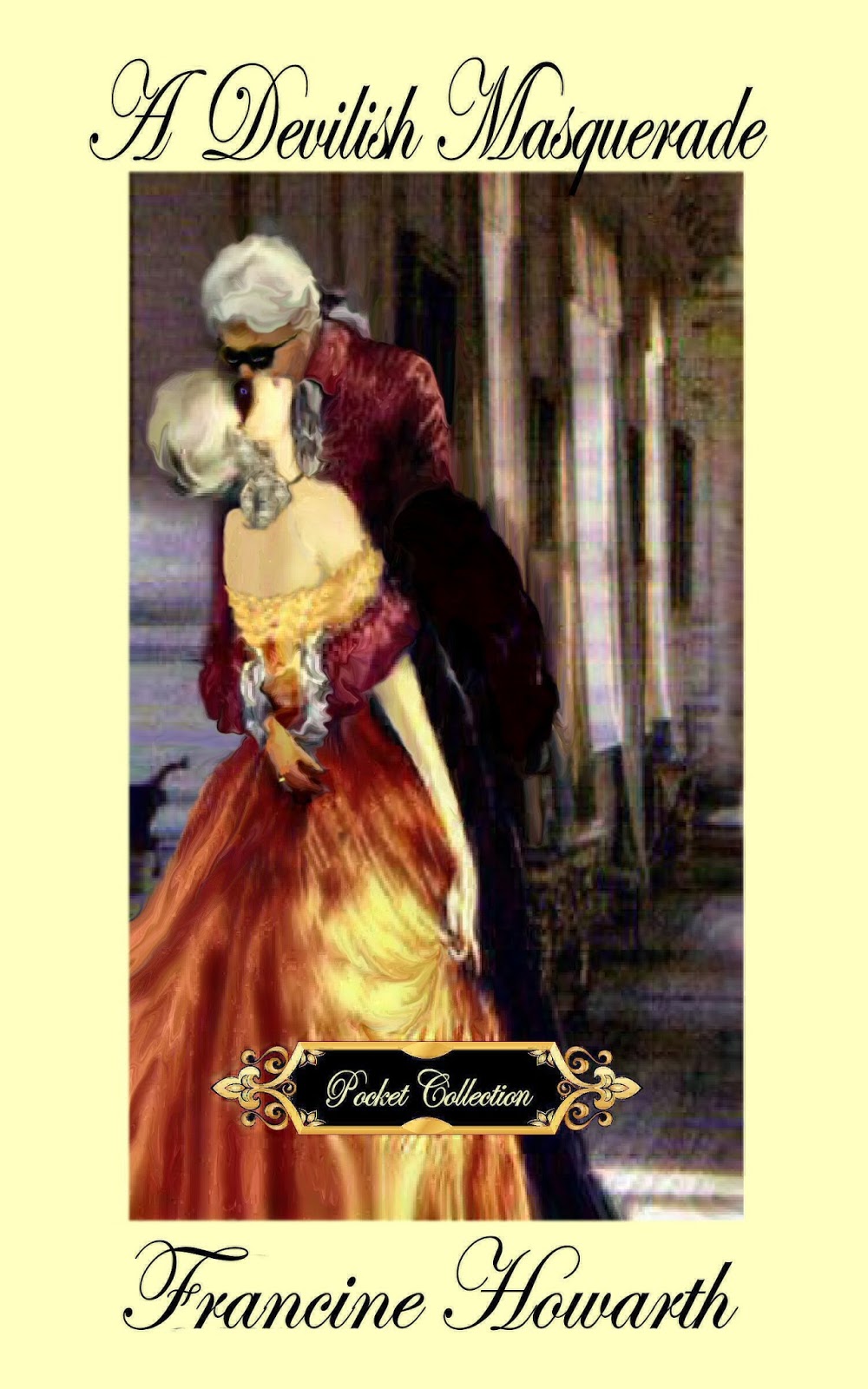
New Steamy Novella.


A Coaching Accident, a Regency New Year Fancy Dress Ball, and a Devilish Masquerade will ensue.

The cynical Melbourne, Earl Standish, has resigned himself to a bachelor existence in which a mistress is a damn sight safer than young chits with mother’s who are hell-bent on securing a title for their daughters. Stealing the cherry as sporting game has never been his gambit, until that is, a coaching accident, involving his sister and the Danby family, thrusts an irresistible young lady into his sightline. Conventions of hospitality must be afforded to the rescuers of his sister, and with a New Year ball imminent at Norton Priory, Standish is hopelessly smitten, but he has two brothers and the elder of the two is a renowned cherry stealer. Can the Earl overcome his misgivings and rejoin the Marriage Mart – and will the rakish brother let him steal away with Cecily Danby?


True to the traditional romance of Regency England coaches and horses feature greatly within Regency novels, and of course coaching accidents were not as uncommon as modern-day thinkers tend to assume. Some coaching accidents were fatal for passengers, especially those thrown overboard from up top,  Other coaching accidents, often in perilous weather conditions were almost as deadly. Thus a coaching accident features in this novella, and is the opening to a tale involving the original Cinderella fairy tale, though Cecy is no poor mistreated Cinderella. But the story reveals all, so I'll leave it there, except to say the coaching accident leads to a stay at Norton Priory, and that  is where Cecy learns who she really is, after seventeen years of believing she is someone else! 


So what does this once ecclesiastical building hold in store for Cecy?  


Amazon US      Amazon UK

Saturday, 7 January 2017

Dispelling Myths - People didn't take Baths

Dispelling Myths - People didn't take Baths in 16th-17th century etc - in reference to Cleanliness is next to Godliness!


In actual fact, throughout history, people bathed more than historians declare - as can be seen within private journals circa 17th century. The reason they wore perfume and carried pomanders was to kill the stench of the streets where the saying Gardy Loo had purpose before the pitching of effluent from chamber pots to street gully. Hence the wealthy abandoned cities in warm weather, as often as they could and retreated to their country abodes. There's a huge myth the aristocracy abided to seasonal Parliamentary sittings - not those who didn't give a toss about politics, and that was the majority. Yes, they had town houses, in many cases owned streets of houses leased out to the middling merchant/trader classes, but in most cases they only attended specific events, and tended to swan about with a mistress rather than have their family with them. Even the court retired to the country - often. The upper merchant class owned their own vast properties, but of course the lower class were unable to take flight to fresh air unless they paid visit to relatives who were a bit farther distant, bearing in mind Chelsea was a village with open green fields as were other places of note such as Putney where there were windmills on Putney heath - Greater London didn't exist!


Casting stone built Roman baths aside, Wooden baths were little different than wooden baths of the 16-17th centuries resembling cut off ale barrels. Not the little brandy and port barrels, the biggies. Then there were tin (Roman baths) carried with armies for officers and tin baths carried on alongside wooden ones for centuries. Then came the Georgian era and the ever present copper pans, kettles, and yes, Baths. Note the differing wooden baths, the tin one used in the Poldark series, and the Georgian copper. 


For more in depth reference go here: 

Saturday, 31 December 2016

New Book Release!

A remote Scottish Castle, Murder, Mystery, and Romance.


You'll probably note the sprig of holly on the book cover, but this is not essentially a Christmas story, even though the seasonal aspect has a small part to play. This is a book that features dark elements, which most die-hard lovers of Sweet Regency Novels - in the vein of Jane Austen - will no doubt hate. But I do aim to reflect the darker side of Georgian and Regency life, combined with the social mores of that period. Thus I give you Lady Caroline, she whom led the Marquis of Rantchester astray (The Dark Marquis) until he took a firm grip on his own life.

Book blurb:

Whilst young Lady Caroline Douglas is plotting to take flight from a disastrous marriage and escape the confines of KilKenneth Castle, betrayal, lust, and the financial bank crisis of 1825 suddenly opens a Pandora’s box of intrigue, murder, and mystery. The newly widowed Lady Caroline faces few choices in light of imminent poverty, the best being to hunt down and marry a wealthy man, the worst to runaway with a penniless lover. Thence unbidden attentions of a would-be laird and with assistance from his strange sister, they conspire to keep Caroline prisoner to his every whim. Thus Caroline turns to essence of the dream smoke to thwart their plans, until a lewd painting leads to dark desires and threat of forced submission to the would-be laird. But romance and escape to love and happiness Caroline had so sought, and never encountered, her fate seemingly lies within a stained glass window depicting a mediaeval knight.   

Monday, 7 November 2016

New release - Love & Rebellion.


My latest novel required immense research through private and state papers, and private letters & journals in order to investigate fully the underhanded deceits that occurred at that time, thus sifting through the propaganda was an enlightening experience. Overall, the Royal Series revolves around two families based in the county of Somersetshire, and selected members of the Royal Court. 

The Gantry's reside at Axebury Hall, 


The Thornton's at Loxton House.


Knoll house has a major part in this novel, as does Henry Gantry, 


While it's never easy to retain a high level of entertainment value alongside essential points of historical accuracy, as a reader I've always despised narrative info dumps of historical matter, thus I do my best to drip-feed historical details via  character eyes, their individual viewpoints, and by way of dialogue. Likewise an unbiased  approach to history is not always as simple as it sounds, but again I do my best to present both sides of any divide, though it is almost impossible to like a person of their time, or an unsavoury character, who's given to evil intents and self-advancement, and at any cost to others' and their loved ones. 


This novel is set at a time in history when deception and court intrigues were as bad, if not worse, than that of outside factions, even where Parliament based influences held sway. For readers unfamiliar with this period in history, it was a treacherous time in more ways than one, not least within royal circles due to long-term grudges, envy, secret marriages, mistresses, illegitimate royal offspring, and power struggles on many levels. 

The Monmouth Rebellion is still talked of in the West Country, more especially surrounding the place where the Duke of Monmouth valiantly led his rebel army to engage with the royal army. What happened has remained engraved on the people of the western counties, there descendants, and across the green swathe of the levels, a low-lying area of Somersetshire. Therefore,  I could do no more than let the characters take centre stage:                  


A page from the Duke of Monmouth's notebook - thus his handwriting!


Book blurb:

A would-be King, a would-be Courtesan, Love and Betrayal. A Heartrending 17th century drama of Love, Desire, and Intrigue.


The Hon Henry Gantry’s covert life, in service to the royal household, is anything but secure. Riddled with guilt over hidden desires and acts of betrayal, Henry’s loyalty to the crown is tested in extreme as anti-Papist fervour reaches a peak of discontent across England. With the sudden illness and death of Charles II, speculation countrywide is of foul play, and the newly declared monarch, James II, takes the throne. Rebellion thus seems the only way to achieve the Protestants’ aims to rid the country of its new Catholic King. Thus, Henry is forever affected by tragic events as they unfold, and the Gantry and Thornton families are once again drawn into a web of courtly deceits.

From the midst of defeat and despair... a scrap of paper is a talisman and hope for a new dawn.

Saturday, 3 September 2016

Daniel Defoe - Rebel Soldier!


What could Daniel Defoe possibly have in common with the Duke of Monmouth?

Well, quite a lot!

If you didn’t know before reading this, then let me introduce you to the rebel soldier “Defoe”, who was a staunch supporter of Monmouth’s cause to topple James Stuart (James II) from his throne. Yes indeed, Defoe fought in Monmouth’s rebel army. Unlike Monmouth, Defoe evaded capture (contrary to many Wiki accounts of Defoe’s life and supposed Kingly pardon) and made safe escape to the Low Countries. There Defoe lived in exile, as had Monmouth. But, when William of Orange ousted his father-in-law from the English throne, the invasion thus notably referred to as The Glorious Revolution, Defoe returned as a mercenary soldier. In self accounts of his own life, Defoe is sparing on detail to do with the Monmouth rebellion, though did say: whilst hiding in a churchyard from royalist soldiers who were hunting runaways from the Battle of Sedgemoor, he read the inscription on a tombstone “Robinson Crusoe” which later became a novel, along with "Moll Flanders".

Extra: Many of Monmouth’s supporters who evaded capture were known to the authorities but never found despite intense searches of houses by brutal means against existing occupants. 

Of those who escaped to the Scilly Isles and other island retreats and thought of themselves as safe and out of reach of the King’s hounds, were soon to learn the awful truth that the king’s vengeance had not dissipated with the brutal finale of Monmouth’s decapitation. 

As naval ships docked or anchored off-shore on those outlying islands so escapees were again forced into hiding or smuggled away in fishing boats to foreign shores. The most dreadful account of Judge Jeffreys enacting a despicable remit, was the sending of privates parts of notables "to the wives/mothers" of those who were hung drawn and quartered. A list of prisoners and their respective fates can be viewed here. 

Friday, 8 July 2016

To shoot a son, or not to shoot him!.


Here's a legitimate way for authors of Georgian & Regency (other) novels to tackle the tricky business of a livid duke or earl who is hell-bent on taking steps to disinherit a son without having to shoot him. Read the post carefully (all of it) because not all is quite as one might imagine re titles (land/s) and entailment.

Although across the centuries numerous titles (and in some cases lands) were bestowed by Kings and Queens to persons who served them well, not all titles came with land or houses initially, or bestowed at a later date. Thus several dukes' received no dom, earls neither, and they had to make do with what they had, even if it was little more than a modest family abode plus an apartment within the royal court - subject to the monarch's whim. In some cases land was gifted by a sovereign for exemplary service at court or for some great feat in battle et al, such as the Duke of Marlborough, thence it was expected of the recipient to build a “house” fit to entertain his monarch. See below: change of entailment by letters patent re the Duke of Marlborough.

As for entailment of land to a title, this was not always applicable nor writ as deed when bestowed *couldn’t be when a title had no land* and such restrictions ultimately fell to the recipient to assign a lawyer to fulfil his wishes for future generations in the event of acquisition of land etc., if he thought it necessary. It was known Queen Bess (Elizabeth I) did stipulate within a few titles and land bestowed that a daughter, in the instance of no living legitimate sons, were entitled to assume the female equivalent (Duchess/Countess) in her own right, though should she marry the husband would take the male title, as would sons or daughters in perpetuity. Similar happened during Charles II’s reign when he bestowed titles upon several of his mistresses, Duchess of Cleveland and Duchess of Portland et al. Similarly, not all subsidiary titles such as Marquis have a marquisate = land associated to and with the title!
The case in which the Duke of Marlborough encountered was devastating:
~

Quote: When the Duke’s only son contracted smallpox and died, he was 16. The Marlboroughs’, of course, were devastated. They had four daughters, but no surviving son. All they had worked for seemed destined to slip into obscurity.

A few years later, on 21 December 1706, Parliament passed an Act which noted that the Duke's titles and honours had been awarded by earlier letters patent "to him and the heirs male of his body" (boilerplate letters patent language). The Act amended the letters patent so that, "failing the heirs male of his body, [the titles and honours would pass] to Lady Harriet, his eldest daughter, wife of Francis Godolphin [later 2nd Earl of Godolphin], and the heirs male of her body." Failing the heirs male of her body, then to her sister, Anne (2nd daughter), Countess of Sunderland, and the heirs male of her body. Failing the heirs male of her body, then to her sister, Elizabeth (3rd daughter), Countess of Bridgewater, and the heirs male of her body. Failing the heirs male of her body, then to her sister, Mary (4th daughter), later Duchess of Montagu, and the heirs male of her body. After an allowance for future daughters of the Duke and their heirs male, the titles will go to the first daughter of Lady Harriet, and her heirs male; failing them, to the second daughter of Lady Harriet and her heirs male, etc.; and so on through each of the lineal descendants of each of the Duke's daughters; and lastly:"to all and every other the issue male and female, lineally descending of or from the said Duke of Marlborough, in such manner and for such estate as the same are before limited to the before-mentioned issue of the said Duke, it being intended that the said honours shall continue, remain, and be invested in all the issue of the said Duke, so long as any such issue male or female shall continue, and be held by them severally and successively in manner and form aforesaid, the elder and the descendants of every elder issue to be preferred before the younger of such issue."

All persons to whom the said honours shall descend shall have the same precedence as was then enjoyed by the said Duke in virtue of the said letters patent bearing date 14 December (1702) I Anne. So you see, and act of Parliament could then be utilised to 


As an aside: During the period of the English Civil Wars (1642-1649) - a lot of the old aristocracy who fought for King and Country (Royalists) duly had land and property sequestered by Parliament as early as 1645, much of it never, not even when Charles II returned to English shores (1660 -Restoration Period), did he grant favours many expected of him, by overturning sequestered land and property to former owners. Thus many aristocrats who returned from exile overseas had titles and no land, (Duke of Buckingham), who thought it canny to court and marry the Parliamentarian General Sir Thomas Fairfax’s daughter in hope his father-in-law would be kind of heart and give back all the D of B’s holdings. Oliver Cromwell having prior given to his General: but father-in-law (Fairfax) didn’t, simply to safeguard his daughter’s future as wife to a known courtly rake: (another story).
Which brings us to the subject of a duke or an earl disinheriting his son – something that cannot be done on a whim if the title and the estate (land) is entailed. But, and this is where authors of Georgian & Regency novels can take a perfectly legitimate spanner to the belief wheel that *all titles and lands* were and are entailed, thus it is perfectly plausible for a duke or earl (lesser) to threaten his son with disinheritance, meaning the title will be his, but not necessarily the whole of the estate. Landed aristocrats were notorious for acquisition of property or land/s as *safe deposits* much like storing gold/dosh under the bed, and there were those who were indeed reckless gamblers, hence tenant rents funded the gambling or properties were heavily mortgaged, sometimes having resulted in insolvency, and in some cases to this day, estates have and are broken up and sold off bit by bit by differing generations.

Sunday, 19 June 2016

St Luke's Hospice - Charity Book!


A Book in loving memory of a person I never knew, but from what I've heard, he was much-loved within the Napoleonic re-enactment scene.  The dedication by staff at Hospices to ensure the passing over of patients from their care to the other life - with dignity and compassion - is second to none.  

~  

Come sit by the camp fire with some of the best historical fiction authors in the business, and listen to the Sarge's tales.... 


The story of a forbidden love affair on the eve of Napoleon's escape from Elba. 


The eerie tale of what happened to Mark Skinner in the orchard at Hougoumont 

Waterloo, through the tear-filled eyes of Marshal Ney 

The story of the Idiots Abroad. 

You will laugh. You will cry. 
You will want to strangle the lot of them... 
... and many more. 


All proceeds go to the St Luke's Hospice in Plymouth, who took such good care of our Sarge. 

And all stories were chosen because he'd have liked 'em.


Wednesday, 9 March 2016

New Georgian/Regency Series - The Trevellians' of New-Lyn


Dear Reader,

A year past I wrote a Romantic Regency Murder Mystery titled For Love of Captain Jack - and shortly after publication day I received a lovely email from a reader. So intrigued by entries from a journal penned by the Captain's deceased mother, the reader expressed interest in knowing a little more about his parents prior to the young captain's story. Of course I did indeed mull the prospect of writing what could become a mini-family series, but to do so would entail writing the books in reverse order. Another problem that arose was in how to reveal the individual viewpoints  of Admiral Trevellian, and that of his beloved Comtesse Montecute, and all without undue exposure of prior events associated with the murders and mysteries within their son's story. Thus Adelle Montecute's journal plays a vital role as the books' progress, spanning the years and lives of the Trevellians. The first two stories are set within the Georgian period, the third most definitely within the Regency era. And I can only hope you will enjoy the stories where two people fall hopelessly in love and defy the conventions and rules of society by indulging  in secret liaisons.   


An emotional and poignant tale of murder, mystery, and romance.

After the dreadful murder of la Comtesse Montacute and her sons, in the grounds of the family château, le Comte and his daughter are mortified by turn of events. Who did it and for what reason? Utterly distraught, they accept the help of an English marquis and return with him to England. A dreadful dilemma then unfolds. A secret tryst between Adelle and a young admiral leads to untold heartache when Adelle’s aunt declares she is spoken for. Thus Adelle would rather risk life on the streets with a fellow countryman than abide to her father and her aunt’s desire to see her wedded to the marquis. But when a man of cold countenance and vengeful nature is hunting her, as he would a fox running ahead of his hounds, she fears the marquis will win the day by means most cruel and dastardly. 


The Admiral's Sin - A Romantic Murder Mystery (The Trevellians' of New-Lyn Book 2)
A Heart-wrenching story of loss, love, and revenge.
.
Wanting to believe the past is in the past and friendship can be reinstated with an old adversary, Admiral Trevellian loses far more than he ever bargained on by trusting the Duke of Norfleet. Betrayal runs deep, so deep Trevellian awakens to discover his wife has stolen away with her French coachman, and fearing the worst that she’s taken their son, Trevellian is further shocked to discover the boy has been left in his charge. Wielding a sword in battle is quite different than wielding one in pure anger and grievance at another’s insane jealousy and destructive bent. But hold the duke to account, Trevellian will, until satisfaction is met with cold steel to flesh. Life for Trevellian is utter purgatory, and whilst he believes death will cease his unbearable pain, his son determines otherwise.


Finally, book 3 - another love story!


It is 1814 Regency England, and Captain Jack Trevellian RN (Royal Navy) has returned home to South Devon. But on the eve of his return, a young woman is murdered. Three more murders occur in quick succession, and Captain Jack is convinced someone wishes to see him dangling from a hangman’s noose. Determined to uncover the identity of the killer, Captain Jack and his army friend Captain Lester Knight, stir more trouble than anticipated when their aristocratic neighbour brings rank to bear in matters of the judicial system.


Although young women in the district are warned to travel about in pairs, when the vicar’s daughter and a young lady (of whom Trevellian is rather attached) hear blood-curdling screams in Lyn Woods, they are thankful Captain Jack provided an armed guard to keep them safe. Nonetheless, wilful, bold and daring, and all for love of Captain Jack, Alathea Velvet Hawkesworth attempts to lure the murderer from the shadows at a grand masque ball. The true identity of the murderous villain is not as imagined, and she fears she will die a terrible death whilst laughter, music and heady scent of roses drift on a balmy evening breeze, and all within a palatial setting.


Monday, 3 August 2015

The advantage of exclusivity at Amazon!


The advantage of exclusivity at Amazon. And yes this may sound a bit like a Promo for Amazon. But that said, I do think Jeff Bezos deserves a pat on the back for giving the great unpublished a worldwide platform that never quite existed before Amazon opened its virtual doors.
 
Indeed there were small on-line presses and a lot of small niche/romance publishers had their own web sites, some with stores, but it was a hit 'n' miss market place for readers and authors alike. OK, so... there were others who first dreamed up mass market on-line e-book stores, some succeeded like Smashwords/Lulu et al, and others dreamed up e-book readers, and yes, Kindle stole the lead on good marketing. Plus Amazon's uploading facility was slick, unlike other cyber platforms, though it's fair to say one or two of the others have improved somewhat, but not all.
 
 
So why have I chosen to keep the majority of my books exclusive to Amazon? Ans: Loyalty! It gave me a second crack at getting my books to readers, some old republished editions along with new ones, and I've found Amazon staff a pleasure to contact, and have in general received a polite and charming personal footnote to e-mail correspondence, except in one case when a female member of staff was clearly having a bad day at work or was simply devoid of social graces, hence her response was curt and unhelpful. But, out of the blue, I received a follow-up e-mail from a male who had taken up my query and had run with it, and the response was great: mission accomplished!
 
So yes, despite the fact other authors complain about Amazon's bully tactics, and at how Amazon's exclusivity deals restrict other opportunities, I'm a fan of Amazon and loyalty is two-way stretch in my little book of honour against the odds, and I'm betting not one of you can claim greater sales on any of the other cyber platforms, and I'll second wager, the majority of your income is acquired via Amazon.


Saturday, 1 August 2015

A Collaborative Charity Project by Award Winning & Best Selling Authors!


Live at Amazon!
 
This anthology comprises novellas penned by not only ex mainstream best selling authors, but self-published and award winning authors as well.  


We dare you to step back in time to the era of The Three Musketeers, Charles I, Charles II. We further dare you to face our swashbuckling heroes and strong heroines, who brave the uncertain times of war and rebellions. If you think only men wield swords, and women don't spy on the enemy, then think again... 


Book Blurb:


War, Rebellion, Love and Romance!

While England is ravaged by Civil War, divided loyalties abound and Victory is not always as imagined. With a king beheaded, a king in exile, and a Lord Protector ruling the land, the future looks certain for many and fraught with danger for others. ‘Tis true to say, characters have shaped their own destinies: but at what price, and what price must be paid for the future?


The Countess Spy – Anita Seymour

Oliver Cromwell is triumphant and the king is dead,

But Elizabeth, Lady Tollemache will never give up on the Royalist Cause and pledges her loyalty to the exiled King.

~

The Price of Convictions – Anna Belfrage

Matthew Graham has the choice between staying in Scotland and Risking death, 

or leaving his homeland and breaking his heart.

Not the easiest of choices...

~

Si tu Dois Partir – M. J. Logue

Russell thought he would never be worthy of the only woman

he’d ever wanted: Thomazine thought he was an idiot...

~

The King’s Courier – Francine Howarth

“Breeches do not maketh man, any more than skirts maketh woman.”

~

The Chambermaid – Andrea Zuvich

“I am as you find me. The wheel of fortune has turned,

And Vauxhall Manor’s rightful heir has returned.”

~

Secrets of a Princess – Kelli Klampe

“They will take you even if they know the cost will be their very life.”

~

Goblin Damn’d – Susan Ruth

“I fear this gentleman does not understand the jeopardy he is in. One cannot simply walk into Woodhall and hold guns to people’s heads.” 

~